German-Managed Industrial Supply Chain Execution for Global EPC Projects
Pipes - Fittings - Flanges
ISO 9001:2015 Certification in progress — TÜV Süd audit on track for Q3 2026 to further solidify our commitment to excellence. We exclusively partner with manufacturing facilities that maintain full compliance with ANSI, JIS, and ISO technical standards, ensuring every valve and pipe component meets project-specific requirements for EPC execution.

„All our components are sourced from our audited network of long-term partners. For full traceability, each component is mapped to an anonymous Manufacturer Code in our Quality Management System.“

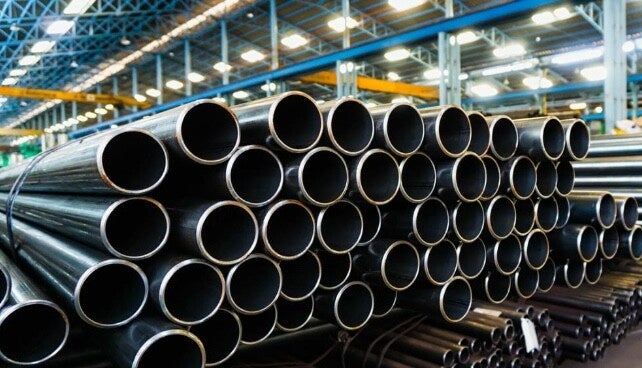
We supply Carbon Steel, Stainless Steel & Alloy Steel Pipes according to DIN,ASME & JIS standards, suitable for industrial and project environments.
-
Seamless and welded pipes - EN 10216 / EN 10217 standards - Material grades on request - Project-based specifications -
Compliance & Documentation of every delivery - We provide complete documentation:
-
EN 10204 3.1 / 3.2 Mill Test Certificates - Material traceability - Inspection and test reports - Full documentation packages for EPC projects & Endusers.
ASME Pipe Standards - ASME B36.10M - ASME B36.19M - ASME B31.1 - ASME B31.3 and more...
Get a Technical Offer Within 24 Hours
Submit your request and receive a structured quotation based on your specifications.
Product - Range and Standards
Pipes
Forged Flanges
Forged & Butt Weld Fittings
The Structural Architecture of International Standards EN,JIS,ASTM
In global manufacturing, a "304" is not always just a 304. Stainless steel performance hinges on strict adherence to regional regulatory frameworks. For procurement teams and engineering departments, navigating the overlapping compliance rules of ASTM, JIS, and EN is critical to securing material integrity and avoiding supply chain friction.
At K&L industries, we engineering-proof your global RFQs. This guide highlights the structural differences between major international standard systems to ensure your components land on time, on spec, and on budget.
Our Standards
All materials are manufactured and delivered in strict accordance with international standards, including:
- International standards: API, ASTM, ASME, DIN
- Third-party inspection available
- Full traceability
- Material Test Certificates (MTC)
- Project documentation support
ANSI / ASME • API Standards • DIN • BS • JIS • GOST • AWWA • SABS • AS / Certification and traceability are integrated into every shipment — .Pressure Classes: ANSI 150 – 2500 PSI
Controlled Supply Architecture
Through strategic factory partnerships, multi-source capacity structuring, and cross-border execution management, K&L ensures:
• Production slot priority • Technical alignment with project specifications • EN 10204 3.1 / 3.2 documentation integrity • On-time global delivery
• Risk mitigation across jurisdictions
In volatile markets, supply chain control defines competitive advantage.
K&L Industries stands at the intersection of European compliance logic and Chinese manufacturing scale — delivering industrial continuity for projects where failure is not an option.


Performance Verified. Not Assumed.
Every product undergoes rigorous inspection and testing protocols to ensure structural integrity and operational reliability in demanding environments:
• High-temperature tensile testing • Impact testing • Flattening testing • Hydraulic pressure testing • Ultrasonic testing (UT) • Liquid penetrant testing (PT)
• Coating thickness inspection • Intergranular corrosion (IGC) testing
Quality is engineered into the process — from raw material to final dispatch.
Quality Assurance & Testing.
Quality is controlled at every stage of production, from raw material inspection to final testing and delivery.
Testing & Inspection Includes
- Hydrostatic Testing
- Pressure Testing
- Material Verification
- Dimensional Inspection
- Visual & Functional Testing
All procedures are aligned with international quality standards and project specifications.
Steel Pipes
Types: ERW Pipes - SSAW Pipes - LSAW Pipes - Seamless Pipes Galvanized Pipes Diameter: 21.3mm-1020mm or as your require
Length: 4m-12m, fixed length available
STANDARDS: ASTM A335, ASTM A500 - ASME B36.10M, ASME B36.19M - API 5L, API 5CT - DIN 1629, DIN 2448 - EN 10210,EN 10216,EN 10217,EN 10297,EN 10088 ISO 3183, ISO 4200 - GB/T 8162, 8163, 3087, 5310, 12771 - JIS G3454, JIS G3459, JIS G3460, JIS G3463, GOST 8732, GOST 10705,
NACE MR0175/ISO 15156
MATERIALS:
Carbon steel: ASTM A53 Gr.A/Gr.B,ASTM A106 Gr.B, - ASTM A500 Gr.C, API 5L (X42-X70), EN 10210 (S235JRH/S355J2H),JIS G3454(STPG370/ STPG410), EN 10210 (S235JRH/S355J2H)
Low-temperature steel: ASTM A333 Gr.6
Stainless Steel: 304/ 316/ 321 / 430,ASTM A790
S31803, EN 10216-5 1.4462
Alloy Steel: ASTM A335 P11, API 5L L80/P110, API5CT L80, ASTM A213 T11/T22, EN 10216-2 13CrMo4-5, EN 10216-4 10Ni14, ASTM B444 Inconel 625(UNS/N06625)


Scope of Supply - Forged Flanges
1.) Forged Flanges : SIZE: 1/2"-192"; DN15-DN4800 / MATERIAL: Carbon Steel: ASTM A105,A105N, SS400, P235GH,P250GH,C22.8,Q235, 20#, 16Mn
Low-temperature Steel: A350 LF2 / Stainless Steel: ASTM A182 F304,F304L,F316, F316L,F321,F347,F310,F44,F51 / Alloy Steel: ASTM A694 F42,F46,F52,F56, F60,F65,F70 - A182 F5,F9,F91,F12,F11,F22
STANDARDS: ANSI/ASME B16.5, B16.47, B16.48, AWWA C207, API 6A/6B/6BX, DIN 2527, DIN 2573, DIN 2576, DIN 2631, DIN 2632, DIN 2633, DIN 2634, DIN 2635, DIN 2566, DIN 2642, EN 1092, BS 4504, JIS B2220, GOST 12820, GOST 12821, SABS 1123, AS 1219, etc.

Butt Weld Fittings
SIZE: 1/2"-72" ; DN15-DN1800
STANDARDS: ASME/ANSI B16.9, ASME/ANSI B16.25,ASME/ANSI B16.28, EN 10253-1,EN 10235-2, EN 10253-4
DIN2605, DIN2509, DIN2615, DIN2616,DIN2617, DIN28011, MSS SP-75, MSS SP-43, GOST 17375, GOST 17376, GOST 17378, GOST 17379, GOST 17380, GOST 30753, JIS B2311, JIS B2312, JIS B2313, JIS B2316,ISO 3419, ISO 5251, ISO 15590
MATERIALS: Carbon steel: ASTM A234 WPB/WPC/WP11/WP22/WP5/WP9/WP91, GB 20#, GB Q235, EN P235GH, EN P265GH,
Stainless steel: ASTM A403 WP304/ 304L/ 316/ 316L/ 321, EN 1.4301/ 1.4404/ 1.4541, GB 0Cr18Ni9/ 00Cr17Ni14Mo2/ 1Cr18Ni9Ti
Alloy steel: ASTM A234 WP1/ WP5/ WP9/ WP11, GB 16Mn/ 15CrMo/ 12Cr1MoV /EN 13CrMo4-5/ 10CrMo9-10
Low-temperature steel: ASTM A420 WPL6/WPL3, GB 09MnNiDR
Duplex Stainless Steel: ASTM A815 UNS S31803/ S32750 EN 1.4462/ 1.4501

Types
Elbows (45°/ 90% 180°) Long/Short
Tees (Equal/Reducer/Lateral/Barred)
Reducers (Concentric/Eccentric)
Caps
Bends (3D,5D,7D,10D, etc)
Crosses
Stub Ends
Insulation Joint
Saddles
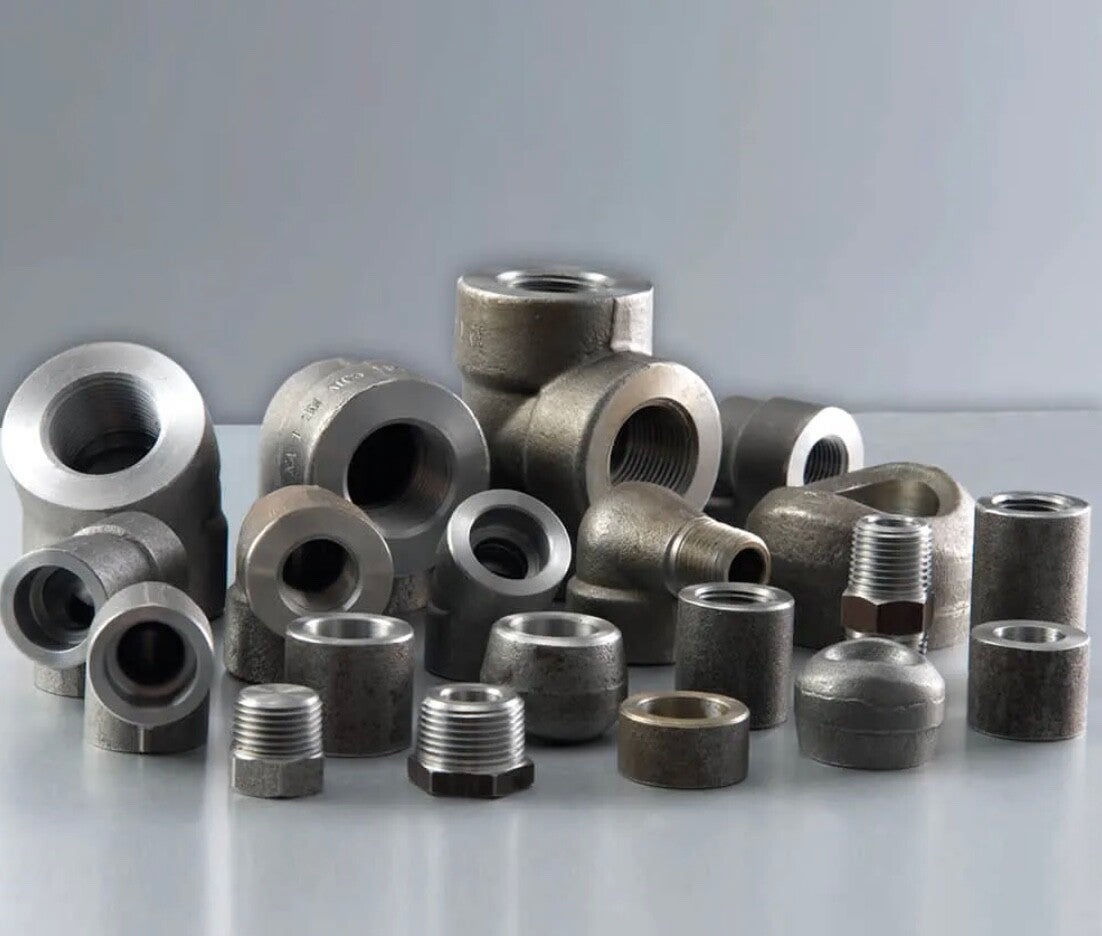
Forged Fittings
SIZE: 1/2"-24"; DN15-DN600 - STANDARDS: ASME/ANSI B16.5 ASME B16.11 ASME B16.34 EN10241 JIS B2316 JIS B2302 MSS SP-83 MSS SP-97
Types: Socket Weld Pipe Fittings & Threaded Pipe Fittings: Elbows(45°/ 90°), Tee, Cap, Cross, Union, Coupling, Olet, Boss, Nipple, Bushing
MATERIALS: Carbon Steel: ASTM A105, ASTM A694 F42/ F52/ F60, GB 20#, Q235B, EN C22.8, EN 10222-2 Low-temperature steel: ASTM A350 LF2
Stainless Steel: ASTM A182 F304/F304L/F316/ F361L/F321/F51/F53/F6a/EN 10222-5
Alloy Steel: ASTM A182 F11/ F22/ F91, Inconel 625, EN 10222-4

The Cross-Border Procurement Guide: Navigating Global Stainless Steel Standards
All materials are manufactured and delivered in strict accordance with international standards, including:

EN-Norm (DIN)
The EN system is a highly regimented, fully unified framework that replaced older national European standards (like DIN or BS). It relies on absolute technical coding to eliminate ambiguity across borders.
- Numerical Coding: Employs a strict five-digit material numbering system (1.xxxx format). For example, standard 304 converts to 1.4301, while 316L maps to 1.4404.
- Procurement Advantage: Combines chemical thresholds, testing protocols, and delivery conditions into a single, cohesive standard sheet.
JIS (Japanese Industrial Standards)
The JIS system prioritizes metallurgical precision and compositional consistency. It is the baseline framework for advanced electronics, automotive components, and precision engineering across Asian supply chains.
- Nomenclature Logic: Utilizes functional prefixes, primarily "SUS" (Steel Use Stainless), directly followed by the compositional chemistry group (e.g., SUS304, SUS316).
- Procurement Advantage: Delivers exceptionally tight tolerances regarding micro-alloying elements, critical for specialized manufacturing.
ASTM International (North American Standard)
The ASTM framework approaches material selection through the lens of product form and engineering application. Rather than grouping materials solely by what they are made of, ASTM dictates properties based on how the steel will be utilized.
- Structural Division: Standards are separated strictly by application (e.g., ASTM A240 for flat-rolled plate/sheet versus ASTM A312 for seamless or welded piping).
- Procurement Advantage: Ensures the specific mechanical tolerances match the mechanical geometry of your final product.
Engineering Your Supply Chain Security
A successful global build requires moving past generic conversions. When submitting a Request for Quote (RFQ) with multi-standard elements, K&L industries recommends establishing one primary dominant standard and explicitly defining your acceptable chemistry variances.
Our global technical desk is ready to audit your engineering drawings to verify that cross-border material specifications match your exact performance requirements.
Cross-Reference Matrix: Primary Alloys
While these grades are frequently traded as equivalents, their internal chemical boundaries and mechanical yield limits vary.
Material ClassASTM DesignationJIS EquivalentEN Numeric StandardAustenitic (Standard)304SUS3041.4301Austenitic (Low-Carbon)304LSUS304L1.4307Marine Grade316SUS3161.4401Marine (Low-Carbon)316LSUS316L1.4404
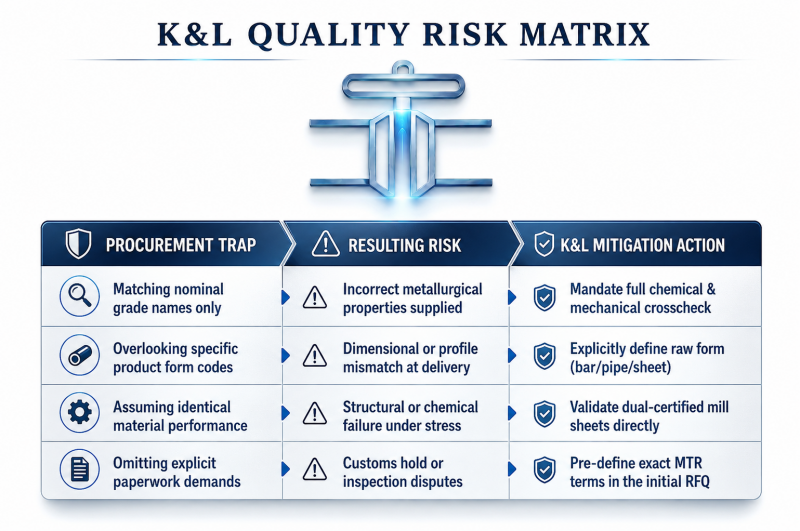
The K&L Risk Mitigation Protocol
To safeguard your projects from engineering failures and custom clearance delays, our quality assurance team treats cross-standard procurement through a strict risk matrix:
Engineering Your Supply Chain Security
A successful global build requires moving past generic conversions. When submitting a Request for Quote (RFQ) with multi-standard elements, K&L industries recommends establishing one primary dominant standard and explicitly defining your acceptable chemistry variances.
Our global technical desk is ready to audit your engineering drawings to verify that cross-border material specifications match your exact performance requirements.